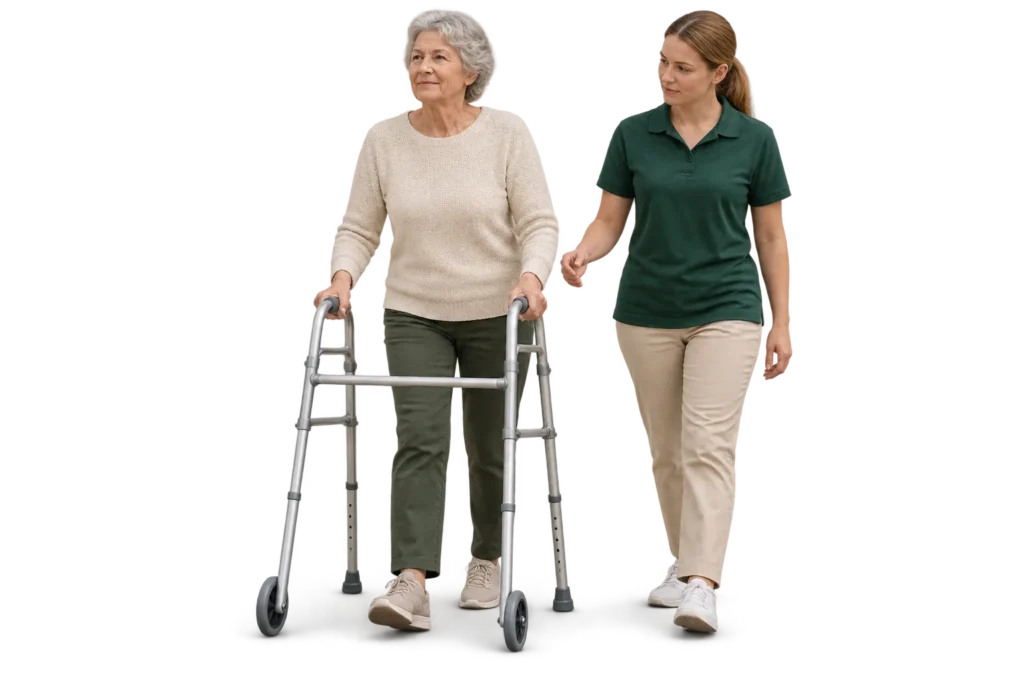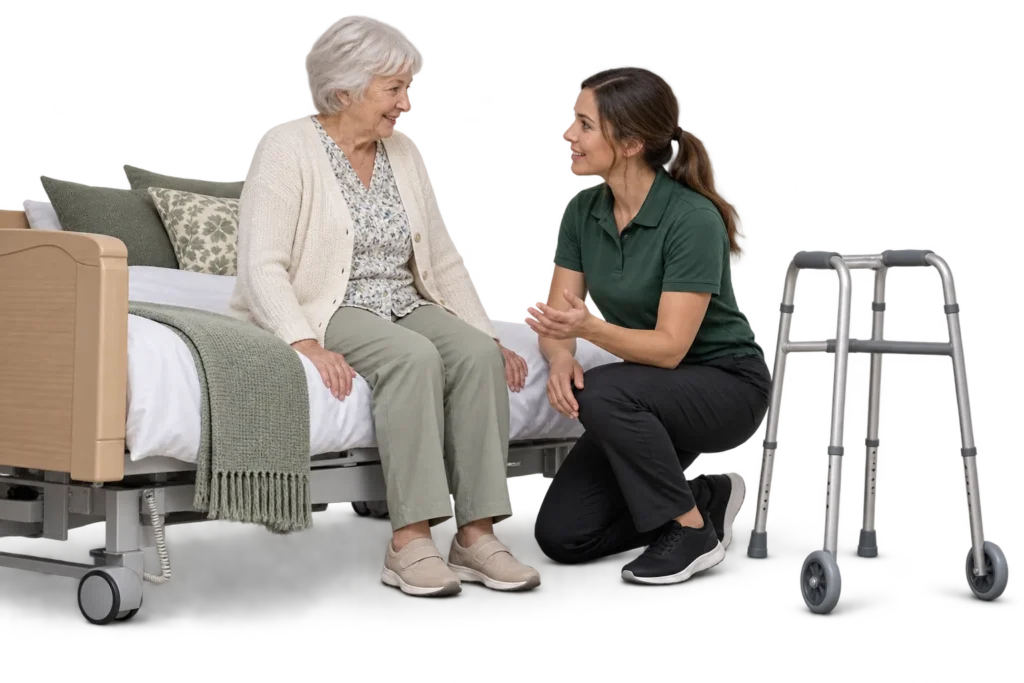
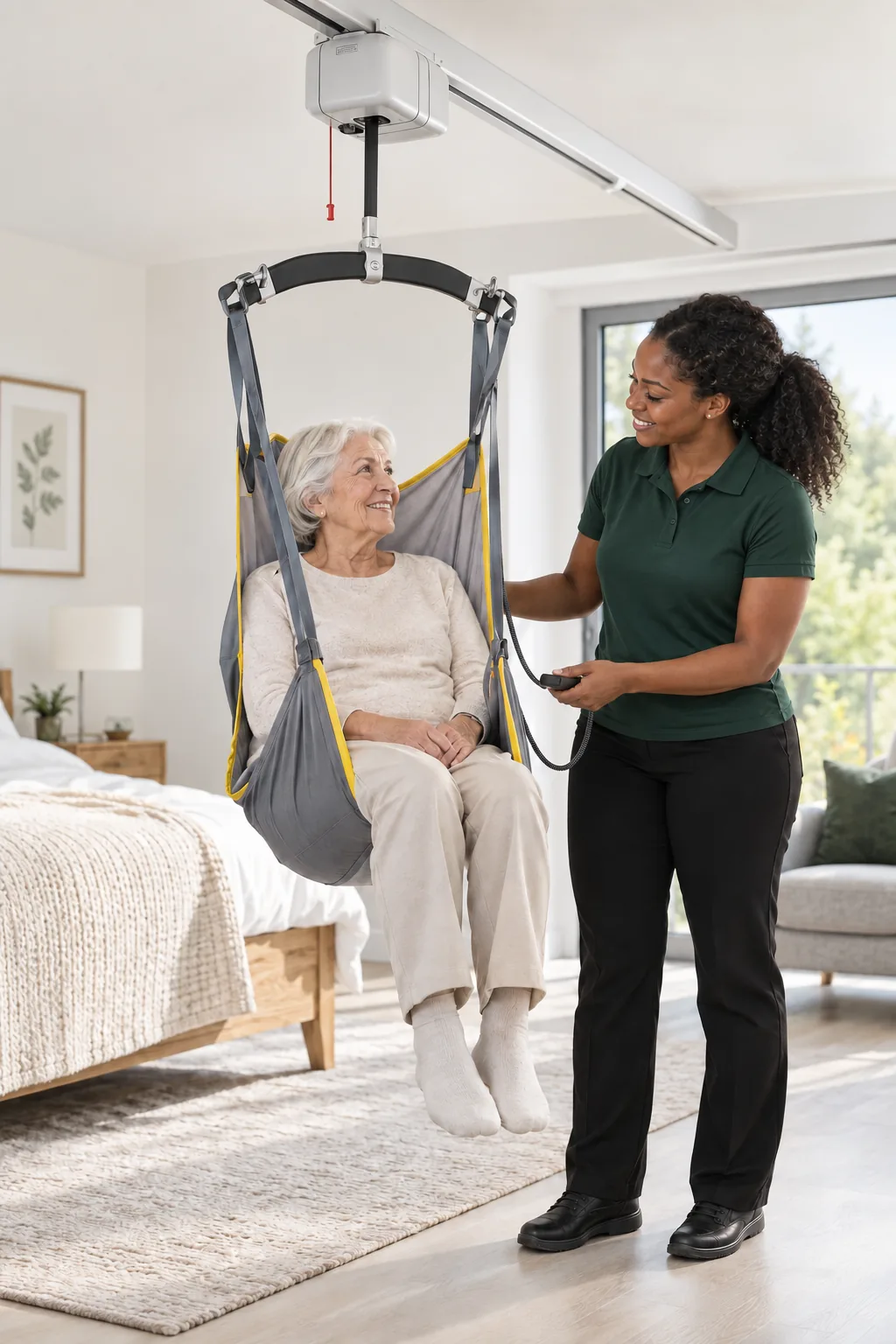
Safety
Safe for the person and for every member of staff, every time — not just on the day of assessment.
01 / 05Moving & handling assessment, rehabilitation and care optimisation — so support is proportionate, safe and independence-focused.
Every recommendation starts with what the person can actually do — observed in the real task, not inferred from a diagnosis.
Ability, consent, pain, confidence and what matters to the person — seen, not assumed.
The demands of each task: sit-to-stand, transfers, bed mobility, walking — and where the risk actually sits.
The least restrictive safe method, the equipment that solves the problem, and the number of carers it genuinely needs.
Trial it in the real environment, teach the technique, fit the equipment and write the plan the team will follow.
A review date and the triggers — a fall, new pain, a change in cognition — that bring the plan back for reassessment.
Change one factor and the safe option changes. Select each to see what we assess.
This is the HSE TILE(O) risk-assessment logic applied to people rather than loads (Manual Handling Operations Regulations 1992). Hoists and slings are lifting equipment under LOLER 1998. Support must be proportionate and promote independence (Care Act 2014), with consent and capacity considered under the Mental Capacity Act 2005. We work alongside the Local Authority’s own assessment — we do not replace it.
Optimal Handed Care (also called single-handed or proportionate care) is an outcome of assessment, never an assumption. Four things have to be true before a package changes.
The right level of support, by the right number of carers, at the right time.
Reducing care is never the objective. Delivering more assistance than a person needs erodes independence and dignity; delivering less is unsafe. The objective is all five of these, together.
Safe for the person and for every member of staff, every time — not just on the day of assessment.
01 / 05The person does what they safely can. Support fills the gap; it does not replace ability.
02 / 05Privacy, choice and participation are designed into the plan, not traded for speed.
03 / 05It still works on a bad day, with a new carer, six months from now.
04 / 05Written so any competent carer can follow it and any reviewer can check it.
05 / 05Function is not fixed. Deconditioning after a hospital stay, a fall or a period of over-assistance is often recoverable — and the care package should follow the person’s function, not freeze it.
Pick the closest service; we confirm the right pathway at triage. Standard fees shown — travel, urgent input and programme work are agreed before you commit.
Assessment of transfers, mobility, positioning, manual handling risks and care requirements.
Optimal Handed Care review of an existing two-carer package or a proposed one-carer pathway — trialled, with contingency and review triggers.
Restore function and independence where possible, around goals that matter to the person.
Identify the equipment that solves the actual transfer problem — person, task and environment together.
Functional, transfer, posture and environmental evidence to support referral to the specialist wheelchair service. Not a direct wheelchair assessment.
The relationship between the person, bed, rails, mattress, accessories and environment.
Half-day, on-site, case-led session for up to six staff, with observed competency sign-off records. Full-day sessions and larger groups quoted.
On-site assessment, review, training and optimisation across a service, scoped to your caseload.
Every assessment ends in a written plan a carer can follow and a reviewer can check. This is what it contains.
What was observed, in which tasks, on which date — and the person’s own goals.
Why this option, why not the alternatives, and what would change the decision.
Risks to the person and to staff (TILE(O)), with the controls that make the task acceptable.
Exact device, size, settings, compatibility and service/LOLER status.
Step-by-step method, what the person does, cues and stop points.
Number of carers, positions, competencies, and who to call when something changes.
A review date, and the triggers that bring the plan back sooner: any reported change in functional ability, weight-bearing, pain or cognition that affects safe transfer or mobility.
Real plans are individual and are shared only through agreed, secure routes.
Independent assessment capacity for Optimal Handed Care from physiotherapists and occupational therapists — working alongside your own OT and social work teams, under your governance, with the clinical reasoning written down.
rise in waiting lists for occupational therapy services in England since 2019.
LGACase for change (Dec 2025), citing Ames 2024of referrals in Kirklees assessed as Optimal Handed Care — ~56,500 care hours a year released, ~£1.1M annual cost avoidance (2017–24).
LGACase study: Kirklees Councilof 651 patients reviewed in Southampton’s OHC pilots had their care needs reduced, releasing 3,039 bed days.
LGACase study: University Hospital Southamptonaverage staff time per double-handed package review — capacity, not intent, holds waiting lists in place.
Peer-reviewedWhitehead et al. 2022, Health & Social Care in the Community30 minutes, no charge. Your area, your waiting list, the cohort you want to start with and the measures you will judge it by.
25 cases at a fixed price per case. Each case: assessment, TILE(O) risk assessment, clinical reasoning, equipment specification, staffing per task, provider sign-off, review triggers.
Against the measures agreed at the start: care hours released, unchanged or increased support (reported with the same rigour), implementation rate, safety events, the person’s experience.
A 50 / 100-case cohort, a rolling caseload at agreed weekly capacity, or a retained partnership with priority response, plan audits and training days.
Standard assessment fees. Referral to report in an agreed timescale. No commitment.
Fixed price per case, inclusion criteria, monthly reporting and an evaluation built in. The usual starting point for a council.
Agreed weekly capacity, priority response for red cases, plan audits, competency training days and a named clinical lead.
Programme prices are scoped per contract and confirmed in writing before mobilisation. Clinical recommendations are never driven by a required saving.
Figures are published national and local-authority evidence, not Thrive outcomes. Every case is assessed individually; where two carers remain necessary, that is documented with the same rigour.
Inspectors compare the written plan with what they see on the floor. Six things we check in the room — select a point, or let it play.
For the staff who deliver it, with the triggers for refresher input: an incident or near miss, new equipment, or a change in the person’s plan.
When a resident’s presentation changes, so two carers are not left in place by default.
Choose the priority you need and it is carried straight into your booking. Clinical triage confirms it from your details. Every pathway stays bookable.
Urgent, non-emergency need where clinically appropriate.
A decision is needed soon.
Scheduled work agreed in advance.
Choose a priority, choose a service, pick a time. Not sure which service? Book a Moving & Handling Assessment — triage confirms the pathway.
Talk to Thrive Better Living about assessment capacity, provider support, rehabilitation and moving & handling optimisation.
A team of physiotherapists and occupational therapists — every clinician with at least ten years of moving & handling, rehabilitation and community practice.
Evidence of registration, insurance, DBS, information governance and safeguarding arrangements is provided for contract due diligence on request.
Reviewing a care package, supporting someone at home, or running a care service — start with the clinical question: what can this person do, and what support is genuinely needed?
07901 603714Not an emergency line — in an emergency call 999.